

Anthony Pignotti and Randall Juip Win No-Cause Verdict for Clients in $135 Million Medical Malpractice Lawsuit
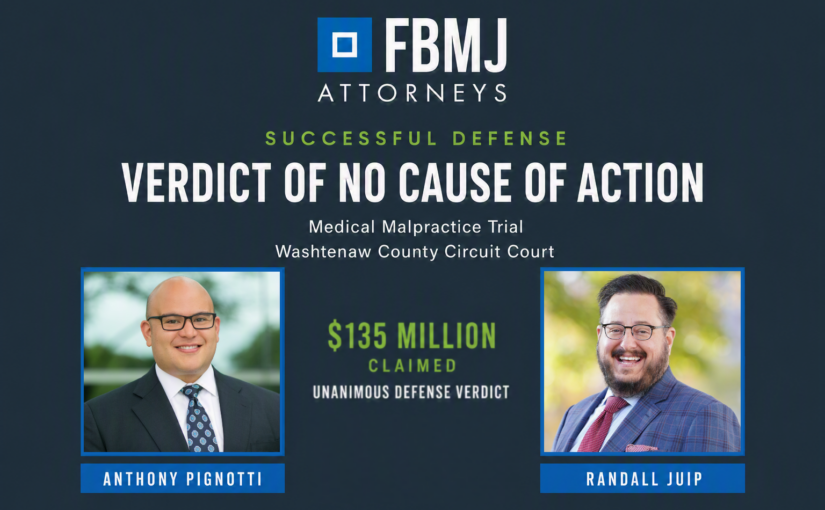
Foley, Baron, Metzger & Juip PLLC Members Anthony Pignotti and Randall Juip, successfully obtained a verdict of no cause of action in favor of their clients in a recent medical malpractice trial in the Washtenaw County Circuit Court. After a two-week-long trial in which the Plaintiffs sought $135 million in damages, the 8-member jury agreed with Tony and Randy and unanimously found that the Defendants were not negligent.
The medical malpractice claims in this case—made against two neurosurgeons and one of Michigan’s largest health care systems—arose out of a very rare neurosurgical procedure called DREZ lesioning. Over 30 years prior to undergoing the surgery at issue, the patient was in a high-speed accident in which he ran into a tree on a snowmobile. As a result, he suffered a brachial plexus avulsion injury in which each of the five motor and sensory nerves innervating his right arm were ripped out of his spinal cord at the level of the cervical spine, leaving his right arm without any function or sensation. Over the years, the patient developed progressive deafferentation pain, which is a severe form of neuropathic pain that is often described as one of the worst kinds of pain imaginable. The patient experienced an unbearable, constant, crushing and burning feeling in his non-functional right arm. The only known treatment for deafferentation pain due to a brachial plexus avulsion is a DREZ lesioning procedure. This surgery is extremely rare and there are less than 15 neurosurgeons in the United States who perform this surgery with any frequency. The area of the spinal cord where the nerve roots were ripped out is known as the dorsal root entry zone (“DREZ”). The DREZ lesioning procedure involves the intentional cutting of the spinal cord in the area of the DREZ in an effort to destroy the dysfunctional nerve centers causing the deafferentation pain. Because the surgery involves intentional injury to the spinal cord, it carries significant risks, including permanent neurological injury and bleeding. Following the surgery, the patient developed a mild right leg weakness, which remained stable to improving, and likely would have gone not to completely resolve, but for the fact that an intramuscular artery started to acutely bleed 8 hours after the surgery. The resulting epidural hematoma was discovered immediately and in less than an hour, the patient was back in the operating room to have his hematoma evacuated.
The plaintiffs claimed that the DREZ lesioning procedure was performed in the wrong portion of the spinal cord and that the epidural hematoma formed shortly after the surgery and progressively worsened over the 8-hour period following the surgery before it was evacuated. Plaintiffs argued had the surgery been performed properly and had post-operative imaging been obtained immediately following the surgery, the patient would not have developed permanent neurological injuries or the enormous damages claimed in the trial. Tony and Randy were able to successfully educate the jury as to the anatomy of the spinal cord and the nature of how the surgery was performed. Through the expertise of their own clients, as well as the nation’s leading expert in DREZ lesioning procedures, an expert that Plaintiffs’ own attorney praised for “writing the book on DREZ lesioning,” the jury was impressed with manner in which the Defendants meticulously performed this very difficult surgery in the appropriate manner, and why the nature of the patient’s own injuries proved that they could not have performed the surgery in the manner claimed by the Plaintiffs. Furthermore, through the testimony of the Plaintiffs’ own experts on cross-examination, Tony and Randy were able to demonstrate to the jury why the patient could not have had an arterial epidural hematoma for more than minutes before it was discovered, thereby proving that the resulting epidural hematoma could not have been evacuated any sooner.
After two weeks in the Washtenaw County Circuit Court, the 8-member jury returned a unanimous verdict of no cause of action in favor of the Defendants. The jury found that both neurosurgeons complied with the applicable standard of care both in the manner in which they performed the DREZ lesioning procedure and in the manner in which they identified and treated the epidural hematoma.
For more information about the case, or FMBJ’s medical malpractice litigation practice, please contact Anthony Pignotti or Randall Juip at (734) 742-1800 or via email at apignotti@fbmjlaw.comor rajuip@fbmjlaw.com.